


New Workplace Exposure Limits are coming to Tasmania on 1 December 2026.
Tasmanian businesses have until 1 December 2026 to prepare for changes to the way workplace exposure to airborne contaminants is managed. From 1 December 2026 onwards, Australia’s Workplace Exposure Standards, commonly known as the WES list, will transition to Workplace Exposure Limits, or the WEL list.
The shift to the WEL list is more than just a name change. It includes changes to exposure limits affecting a range of industries and workplace activities.
Employers should review their workplace hazards, risk assessments and control measures well before the new limits take effect.
Visit Safe Work Australia’s website to learn about workplace exposure limits (WELs), including top tips to comply with workplace exposure limits, and stakeholder resource packs.
What are Workplace Exposure Limits (WEL)?
Workplace Exposure Limits (WEL) are the maximum concentrations of airborne contaminants (dust, fumes, vapours, gases, mists) that a person can be exposed to in the workplace without suffering serious or long-term harm.
Which Tasmanian workplaces will be affected?
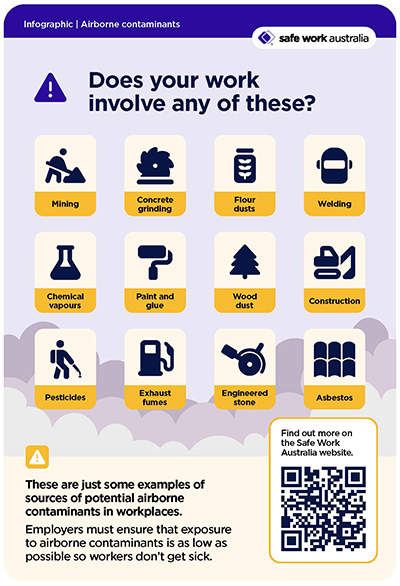
The updated limits apply to all Tasmanian workplaces where workers or other people may be exposed to airborne contaminants. WorkSafe Tasmania has identified several industries and activities that may be significantly affected by the new exposure limits, including:
Diesel-powered equipment and vehicles - New exposure limits for diesel particulate matter (DPM), a change affecting many workplaces that use diesel-powered plant, vehicles and equipment.
Welding, Fabrication and Engineering - Changes affecting common welding contaminants, including manganese, cadmium, cobalt, nickel compounds and Chromium VI.
Road Construction and Asphalt - Changes affecting bitumen fumes and some PAH-containing materials.
Mining and Mineral Processing - New and revised exposure limits affecting diesel particulate matter and several metal contaminants.
Construction - Changes affecting cement dust.
Forestry, Sawmills and Timber Processing - Reduced exposure limits for wood dust and new requirements relating to diesel particulate matter.
Food Manufacturing and Bakeries - New exposure limits for flour dust and flavouring agents, and revised limits for grain dust.
Healthcare and Sterilisation Services - Changes affecting sterilisation and disinfection chemicals, including ethylene oxide.
Agriculture, Grain Handling and Pest Control - New and revised limits affecting pesticides, agricultural chemicals and grain dust.
Automotive Refinishing and Coatings - Changes affecting spray-painting isocyanates and commonly used solvents.
Chemical Manufacturing - Multiple new, revised and removed exposure limits across a wide range of chemicals.
Plastics, Resins and Composites - New and revised exposure limits affecting plastics manufacturing and composite materials.
Laboratories and Research - New exposure limits for several specialist chemicals used in research and testing.
However, these changes are not limited to the industries listed above. Any workplace that uses hazardous chemicals or generates dusts, fumes, vapours, gases or mists should review the revised WEL list and assess whether the changes affect their operations.
Visit Safe Work Australia’s stakeholder pack to access industry specific resources
What are non-threshold carcinogens (NTGCs)?
As part of the transition to the WEL list, some carcinogens have been reclassified as non-threshold genotoxic carcinogens (NTGCs). For these substances, workplace exposure limits have been removed because there is no identified level of exposure that is considered safe. Businesses that use or generate NTGCs must focus on eliminating exposure where reasonably practicable, or otherwise minimising exposure so far as is reasonably practicable. These changes may affect a range of industries, including welding, metal processing, healthcare, research and chemical manufacturing
For more information, visit Safe Work Australia's guidance on Workplace Exposure Limits (WELs) for airborne contaminants
What WorkSafe Tasmania Will Be Looking For?
From 1 December 2026, WorkSafe Tasmania will expect businesses to understand how the new Workplace Exposure Limits (WEL list) affect their workplace and take reasonable steps to manage any risks.
Good record keeping is essential. Businesses should be able to demonstrate that they have identified airborne contaminants used or generated in their workplace and reviewed them against the revised WEL list; that appropriate controls, air monitoring and health monitoring are in place where required; and that all workers, including contractors and labour-hire workers are protected from exposure risks.
What Employers Should Be Doing Now?
If you are a PCBU, you should prepare for the adoption of the WEL before 1 December 2026. You should do this by identifying, assessing and controlling the risk posed by the airborne contaminant hazard.
- Identifying the hazard – you should consult the WEL list to see what airborne contaminants you use or generate in the workplace and the new limits after 1 December 2026 are. If you are already aware of the airborne contaminants in your workplace, check the WEL list to see if the limit has changed.
- Assess the hazard – You must ensure that no worker is exposed to an airborne concentration of an airborne contaminant that is higher than the WEL. If you are unsure about whether you exceed the WEL or not, you must conduct air monitoring.
- Control the hazard – You should identify and implement appropriate controls to implement to ensure that your workplace does not exceed the WEL. You should always aim to eliminate the airborne contaminants. But if it is not reasonably practicable to eliminate the hazard, then you must minimise the risk posed by the hazard by following the hierarchy of controls. You should review your control measures to make sure they work as planned.
Safe Work Australia (SWA) is currently developing guidance and other material to support the transition to the WEL list which will be published on their website throughout the transitional period and beyond. Visit the airborne contaminants hub for more information.
Please contact WorkSafe Tasmania on 1300 366 322 if you have any questions about preparing for the WEL list.
Your Questions Answered (FAQ)
Find answers to common questions about the new workplace exposure limits, what they mean for your workplace and how to prepare for the changes.
Why are the workplace exposure standards changing to workplace exposure limits?
Workplace exposure standards (WES list) were first adopted in 1995, with the last comprehensive review occurring in 2003. In 2024, as the result of a comprehensive review of the scientific justification for the WES list, WHS ministers agreed to changes to the WES list.
In addition, in 2018 WHS ministers agreed to rename the WES list to the Workplace Exposure Limits (WEL list) to communicate that the values are limits not to be exceeded and to align Australia with language used internationally.
When should I start making changes at my workplace?
You should conduct a review of controls as soon as possible to determine what, if any, changes need to be made prior to 1 December 2026.
How do I know if my workplace meets the new requirements?
If you are unsure whether worker exposures exceed the new WEL list, personal exposure monitoring for the relevant chemical must be undertaken.
An occupational hygienist can provide advice on whether air monitoring is likely to be required.
Who should conduct air monitoring?
Air monitoring should be conducted by a person with relevant qualifications and experience, such as an occupational hygienist.
Are new workplace exposure limits for welding fume being enforced?
Yes. Welding fumes are subject to workplace exposure limits and businesses should review their welding processes and existing controls to determine whether exposures are adequately controlled.
Controls may include:
- On-tool extraction
- Local exhaust ventilation
- Mobile extraction systems
- Process changes
- Respiratory protective equipment where required
The controls required will depend on the welding process, materials being welded, duration of exposure and workplace conditions.
If a chemical is in the WEL list, can it be tested?
Generally, yes. Different chemicals require different sampling and analysis methods. If a chemical has a WEL, there are generally recognised methods available to measure worker exposure, although the technique used will vary depending on the substance.
An occupational hygienist can advise on the most appropriate monitoring method.
Does the new WEL list cover pesticides?
Yes. The new WEL list includes a number of pesticides, including some organophosphate pesticides that were not previously listed.
Businesses using pesticides should review the updated WEL list to determine whether any substances they use are now covered.
Can you exceed a WEL if it only happens occasionally?
No. Workplace exposure limits are designed to help protect workers from adverse health effects and the applicable exposure limit should not be exceeded.
Even if an exposure only occurs occasionally, it may still be significant. Exposure is not just about what happens on a single day. If a worker is exposed above a limit once a week, that exposure can add up over months and years of employment.
That's why businesses should investigate the cause of any exceedance and review whether existing controls remain effective.
The aim should not be to work right up to the limit. The aim should be to eliminate or minimise exposure so far as is reasonably practicable.
How long do you need to measure to get a representative sample?
It depends on the substance, the work being performed and the exposure limit being assessed.
Full-shift monitoring often provides the most representative result because it captures exposure across the workday. However, shorter sampling periods may be appropriate in some circumstances.
The ideal monitoring strategy will depend on what work is being undertaken, how long the task lasts and what contaminant is being assessed. An occupational hygienist can advise on the most suitable sampling approach.
Should exposure monitoring be personal or static?
Personal exposure monitoring is generally preferred when determining a worker's exposure.
To determine whether exposure exceeds a WEL, you need to know what the individual worker is actually breathing.
A static monitor on the other side of a room may provide useful information about general workplace conditions, but it doesn't necessarily tell you what a worker standing next to the source is being exposed to.
Static monitoring may still have a role in some circumstances, but personal monitoring is generally the better indicator of worker exposure.
Can monitoring results from one worker be used for other workers?
Sometimes. Monitoring may be representative where workers:
- Perform similar tasks
- Work under similar conditions
- Have similar exposure profiles
A like-for-like approach can be reasonable where exposure circumstances are comparable.
However, if tasks, processes or environments change, it may be reasonable to conduct additional monitoring.
What is the best first step? Should we engage an occupational hygienist?
Not necessarily. A good first step is to conduct your own review.
Go through the chemicals used or generated in your workplace and understand what workers are actually working with. Review the controls already in place and ask:
- What substances are we working with?
- What WELs apply?
- What controls do we already have?
- Do we have effective ventilation?
- Do we have extraction systems?
- Can exposures be reduced further?
There may be improvements you can implement immediately.
If the workplace is particularly complex, or you're unsure how to assess exposure risks, an occupational hygienist can assist with a more detailed review and monitoring program.
How often does air monitoring need to be conducted?
There is no single monitoring frequency that applies to every workplace. The appropriate frequency will depend on factors such as:
- The substance involved
- The level of risk
- Previous monitoring results
- Whether workplace conditions have changed
If a process has remained unchanged over a long period and reliable monitoring data already exists, less frequent monitoring may be sufficient. More variable processes may require monitoring to be conducted more regularly.